
How to Mark Your Belongings: 8 Methods to Prove Ownership and Get Things Back
If your bike, laptop or camera turns up at a police station or in a lost property office, how would anyone know it’s yours? Marking your belongings does two jobs: it helps you prove ownership and helps finders get items back to you. Here are eight methods, what they’re best for and how to combine them.
The short answer
Use two layers: a permanent or hidden ownership mark (serial numbers, registration, engraving, UV pen or forensic marking) to prove the item is yours, plus a visible contact method (label or QR tag) so an honest finder can return it. Avoid putting your full home address on items like keys and bags.
8 ways to mark your belongings
| Method | Visible? | Proves ownership | Helps finders contact you | Best for |
|---|---|---|---|---|
| Record serial numbers | No | Yes | No | Electronics, bikes |
| Product registration | No | Yes | Sometimes | Electronics, bikes |
| Engraving | Yes | Yes | Only if contact info engraved | Bikes, tools, valuables |
| UV pen | No (under UV light) | Yes | No | Electronics, valuables |
| Forensic marking liquid | No | Strong | No | High-value items |
| Name labels | Yes | Weak | Only if contact info included | Kids’ items, clothes |
| Contact stickers / tags | Yes | Weak | Yes | Bags, keys, electronics |
| QR tags | Yes | Moderate (photo, description) | Yes, privately | Keys, bags, luggage, pets |
1. Record serial numbers
Photograph serial numbers and keep them in a secure note or cloud folder. They help police, insurers and marketplaces identify your item.
2. Register products
Many manufacturers and national bike registers let you record ownership. Registered items are easier to trace if recovered.
3. Engraving
Permanent and visible. Useful for tools and bikes. Think about privacy before engraving an address.
4. UV pens
Invisible marks that show under ultraviolet light. Cheap and discreet, but can fade — reapply periodically.
TagTrek turns any item into a smart QR tag. If it's lost, whoever finds it can reach you in seconds — no app, no account, no GPS tracking.


5. Forensic marking
Special liquids with unique codes registered to you. Strong evidence of ownership and sometimes a theft deterrent, often used for high-value items.
6. Name labels
Great for kids’ things and clothes. How to label kids’ belongings.
7. Contact stickers and tags
A phone number or email label lets finders reach you. Use a number you don’t mind sharing.
8. QR tags
A QR tag links to a page where a finder can contact you — you choose what they see, and you can update it anytime. QR code stickers for your belongings.
What to use for each item
| Item | Suggested combination |
|---|---|
| Bike | Frame number recorded + registration + engraving or forensic marking + contact tag |
| Laptop / tablet | Serial number + registration + UV mark + QR sticker on lid or sleeve |
| Phone | IMEI recorded + Find My / Find Hub + contact sticker on case |
| Camera | Serial number + contact tag on strap + “if found” photo on card |
| Luggage | Distinctive markings + contact tags outside and inside |
| Keys | QR or contact tag without address |
| Pet | Microchip + collar tag |
A privacy note on addresses
Postcode marking has been recommended by some police forces for valuables kept at home. But for items that travel — keys, bags, luggage — a visible home address can be a security risk. Use a contact method that doesn’t reveal where you live. What to put on a luggage tag.
The bottom line
Mark your belongings in two layers: something permanent or hidden that proves ownership, and something visible that lets a finder contact you. Record serial numbers, register what you can, and tag the things you carry out of the house.
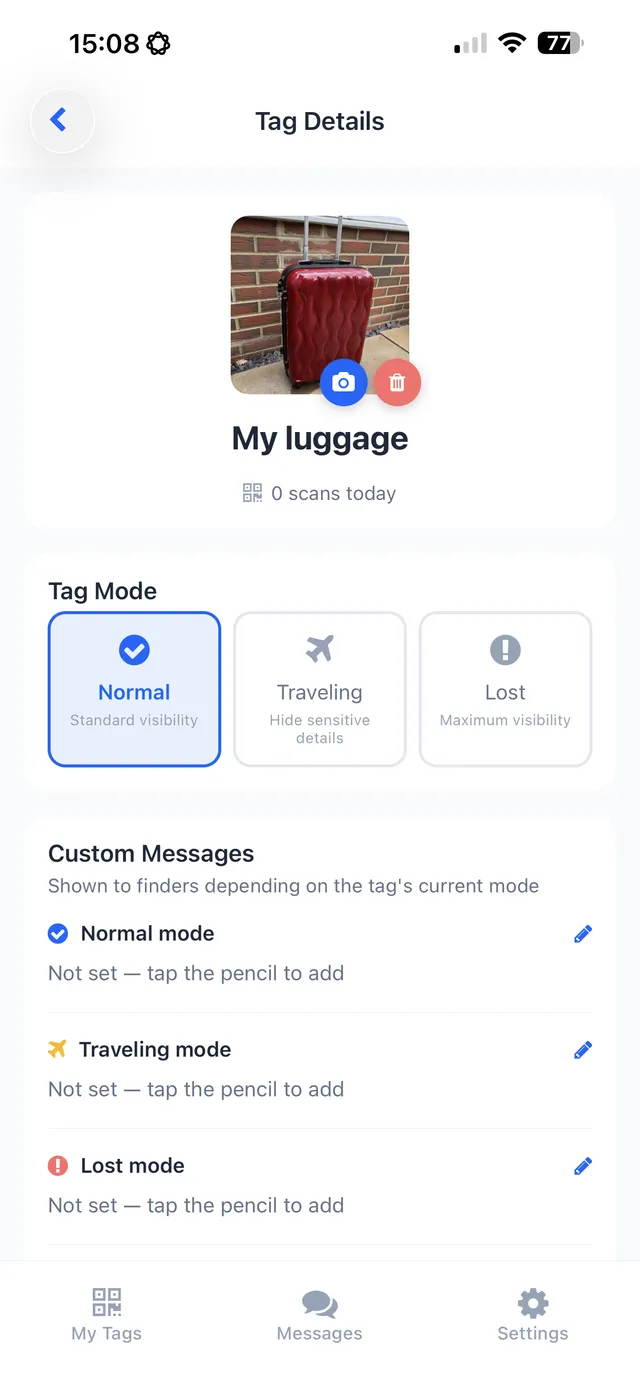
TagTrek covers the visible layer: create a tag for each item with its name, description and photo, print the QR, and choose what finders see in Normal, Traveling and Lost modes. They scan with any phone — no app — and contact you without seeing your address.
Frequently asked questions
What is the best way to mark my belongings?
Combine two approaches: a hidden or permanent mark to prove ownership (engraving, UV pen, forensic marking or registration) and a visible contact method so an honest finder can return the item.
Should I engrave my postcode on my belongings?
Police in some areas have recommended marking valuables with a postcode and house number. Weigh this against privacy — a visible address on items like keys or bags can be a security risk.
Does property marking help recover stolen items?
It can. Marked and registered items are easier for police to identify and return, and marking can deter theft.
How do I mark electronics?
Record serial numbers, register products with the manufacturer, use a UV pen on a hidden surface, and add a contact sticker or QR tag to the case.
Never lose your bag again
TagTrek turns any item into a smart QR tag. If it's lost, whoever finds it can reach you in seconds — no app, no account, no GPS tracking.