
QR Code Luggage Tags vs Paper Tags: Why Paper Tags Fail and QR Doesn't
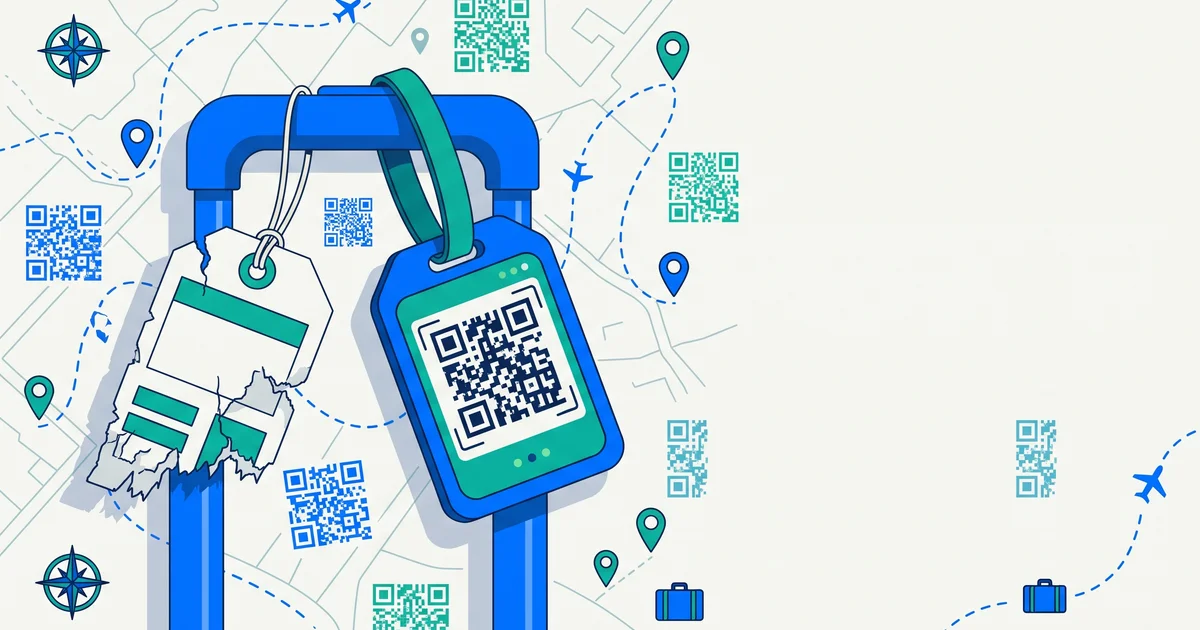
Every airline counter hands out the same thing: a small paper tag with a plastic sleeve and a strip of blank space for your name and number. It’s free, it’s fast, and it fails constantly. If you’ve ever watched your own bag come around the carousel with its paper tag torn half off, you already know the problem. Here’s how paper tags actually stack up against QR code tags, feature by feature.
The short answer
Paper tags fail in three predictable ways: they physically tear off during baggage handling, the handwritten or printed info fades or smudges, and the small space forces you to write down info that goes stale the moment your travel plans change. QR code tags fix all three — the tag itself is a durable sticker or fob rather than a flimsy paper loop, and the contact information behind the code lives on a server you can update anytime, not on the tag itself. The tradeoff is a small upfront cost versus the free paper tag airlines hand out.
Head-to-head comparison
| Paper tag | QR code tag | |
|---|---|---|
| Durability | Tears, gets crushed, plastic sleeve cracks | Durable sticker or hard tag, built for handling |
| Legibility over time | Fades, smudges, handwriting degrades | Digital info never fades |
| Info shown to a finder | Whatever fits in a tiny space, fixed at write-time | Whatever you choose, editable anytime |
| Updating contact info mid-trip | Not possible without a new tag | Update instantly from your phone |
| Privacy | Full name/number visible to anyone who looks | You control exactly what’s shown, when |
| Works with no app | Yes | Yes — opens in any phone’s camera/browser |
| Typical cost | Free at airline counter | Small one-time cost, reusable for years |
Why paper tags fail specifically
It’s not that paper tags are a bad idea — a visible name and number genuinely does help a finder return your bag. The problem is execution:
- They tear off. Baggage handling systems are rough on anything not securely fastened, and a paper tag’s thin plastic sleeve is one of the most fragile things attached to a bag.
- They fade and smudge. Ballpoint pen on paper, sealed in a cheap plastic sleeve, doesn’t hold up to humidity, rain, or months of handling if you reuse the same tag across trips.
- The space is tiny. You get room for a name and maybe one phone number — no room for “traveling until the 14th, reachable at this other number,” which is exactly the kind of detail that matters most while you’re away from home.
- The info goes stale. If you write your home number but you’re reachable by WhatsApp while abroad, or your travel dates change, there’s no way to update a paper tag without replacing it.
Why QR code tags solve this differently
A QR code tag doesn’t put your information ON the tag — it puts a link on the tag, and the information lives on a page you control. That distinction is the whole difference:
- The physical tag just needs to survive, not communicate. A durable sticker or fob holds up to handling far better than paper-in-plastic.
- You can update what a finder sees at any time — change your contact method before a trip, switch to a temporary number while traveling, or update your city without touching the physical tag at all.
- You can choose what’s visible. Instead of a name and number sitting in plain sight for anyone who glances at your bag, a QR luggage tag can show a controlled amount of information and let a finder message you without ever seeing your real phone number.
TagTrek turns any item into a smart QR tag. If it's lost, whoever finds it can reach you in seconds — no app, no account, no GPS tracking.


What about the privacy tradeoff?
A fair concern with paper tags is that they expose your name and phone number to literally anyone who looks at your bag — at the carousel, in an overhead bin, at a hotel. A well-designed QR tag can actually be more private, not less, because the finder scans a link rather than reading your details directly. For more on how that works and what a QR tag does and doesn’t share, see are QR luggage tags safe.
What about smart trackers like AirTags?
QR tags and Bluetooth trackers (AirTags, Tile) solve different problems — a tracker tells you where a bag roughly is if it has power and network coverage nearby, while a QR tag lets any stranger who physically finds your bag contact you immediately, with no app or account needed on their end. See smart luggage vs smart tags and QR tags vs AirTags for how these actually complement rather than replace each other.
Making your own QR tag, or buying one
If you want to build your own rather than buy a pre-made one, see how to make a QR code luggage tag for the practical steps, including what information is actually useful to put behind it.
The bottom line
Paper tags aren’t useless, but they fail in exactly the moments you need them most — worn off during handling, faded from age, or carrying a phone number you can’t be reached at anymore. A QR code tag fixes the durability problem and the staleness problem at once, since the tag survives the trip and the information behind it can be updated anytime. TagTrek’s QR tags are built for this specifically — durable, privacy-first (no GPS, no exact location shared), and readable by any phone’s camera, so a found bag has an actual path back to you instead of a torn strip of paper.
Frequently asked questions
Why do paper luggage tags fail so often?
They tear off in baggage handling, the ink smudges or fades from moisture and UV exposure, and the small handwritten space rarely fits more than a name and one phone number — which may be outdated or unreachable while you're traveling.
Are QR code luggage tags actually better, or just newer?
They solve the specific failure modes of paper: the tag itself is durable, and the information behind the QR code can be updated anytime without replacing the tag, so it doesn't go stale the way a handwritten number does.
Do I need an app to scan a QR luggage tag?
No — any modern phone camera can open a QR code link directly, and a well-built tag opens a simple web page, not an app download prompt. That's what makes it usable by airport staff, hotel staff or strangers who find your bag.
Is a QR code tag more expensive than a paper one?
A basic paper tag from an airline counter is free, but a durable QR tag is usually a modest one-time cost — often less than a single checked-bag fee — and it lasts for years instead of one trip.
Never lose your bag again
TagTrek turns any item into a smart QR tag. If it's lost, whoever finds it can reach you in seconds — no app, no account, no GPS tracking.